A shared backlog for coding agents
Your agents keep working.
You only step in when it matters.
ClankerBar gives your coding agents a structured queue to pull work from over MCP. They claim tasks, ask questions when blocked, and submit completed work for review. Code stays on your local machine; steering happens in one place.
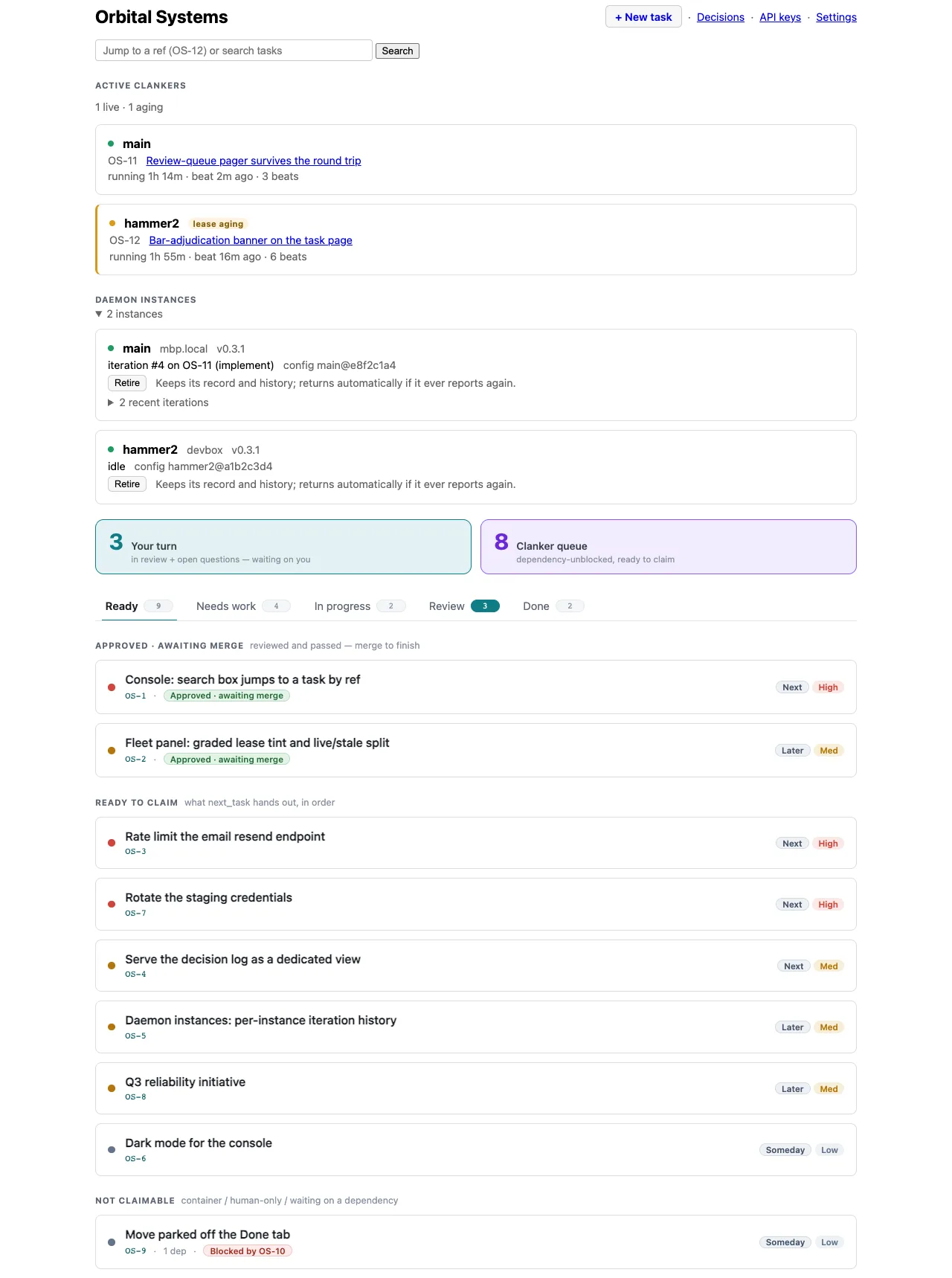
in review + open questions — waiting on you
unblocked and ready to claim
Every view answers one question first: whose turn is it?
Execution stays local. Coordination goes remote.
Your agent runs where your code, environment, and test suites already live. ClankerBar handles the state that shouldn't be trapped in a single terminal session: what to do next, what's been decided, and what needs human eyes.
Point any MCP-capable agent at it
Requires one .mcp.json entry and an API key. No custom plugins, forks, or complex frameworks required.
Designed for multiple workers
Claims are atomic, so the first agent wins. Run agents on multiple machines without them stepping on each other — and see the whole fleet from one board: what each machine is doing right now, and which one has gone quiet.
A pipe, not a judge
ClankerBar records state without interpreting it. Agent recommendations and human rulings are explicitly tracked and cleanly separated.
The end-to-end loop
File work, set priorities, and let agents execute. Step in only when human judgment is explicitly required.
01 — Claim
Agents pull their own work
Agents request the next unblocked task and claim it automatically. No manual task assignment or terminal babysitting. Every board leads with the split that matters: what's waiting on you, and what's ready to claim.
02 — Ask
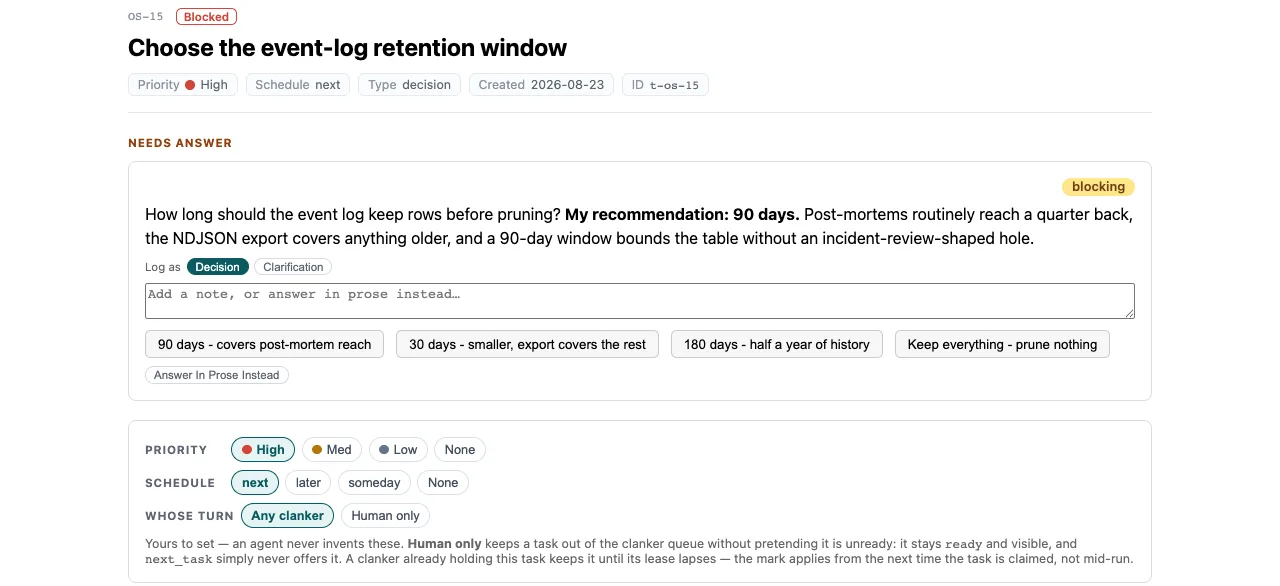
Blocked beats guessing
When the call is yours to make, the agent posts a question with its reasoning and proposed options rather than guessing. You unblock it with a single click — and logged as a decision, the answer is handed to whoever claims next.
03 — Review
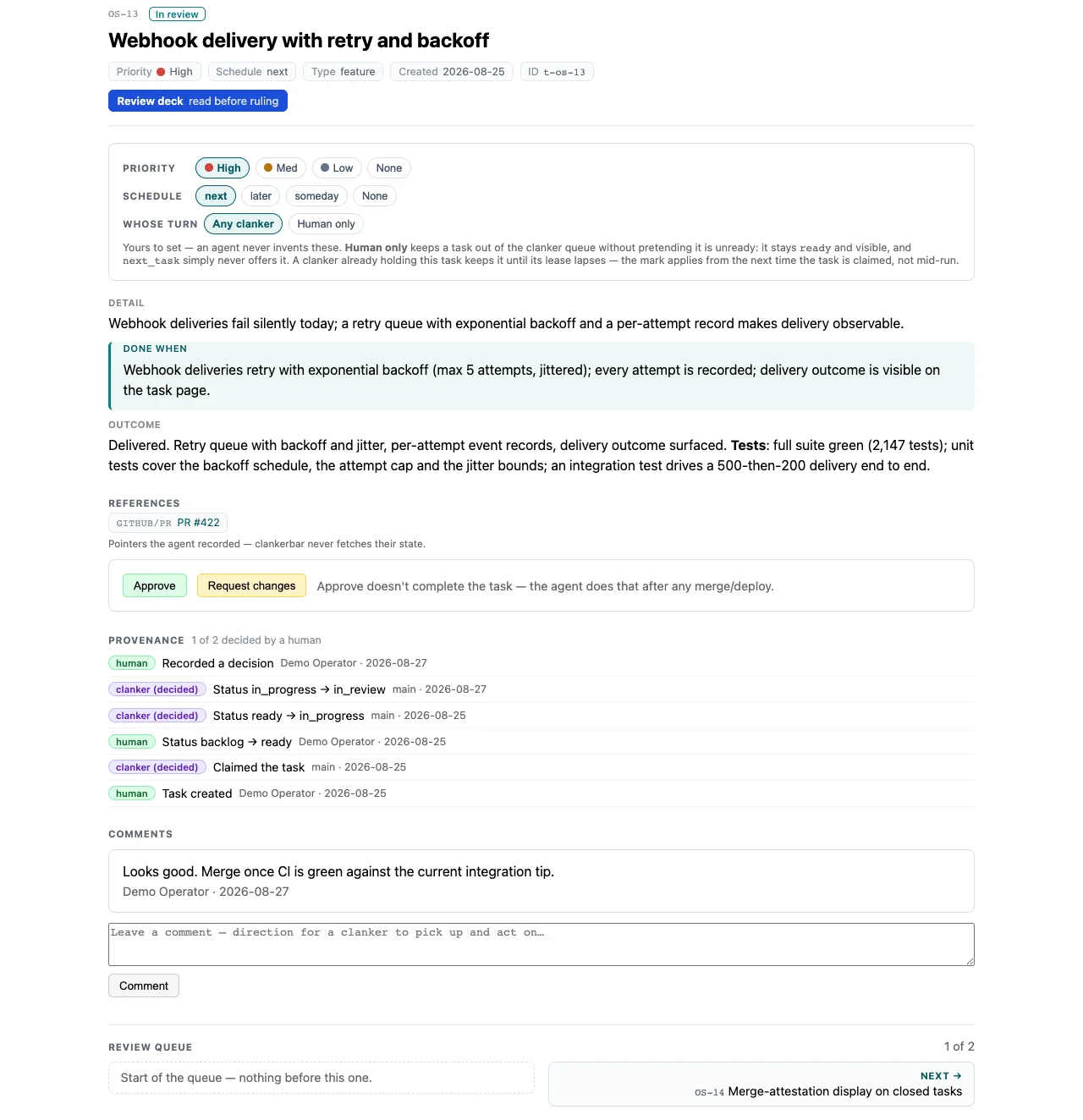
Verification over code diffs
Completed tasks arrive with verification proof, test outcomes, and execution context. Review against the original criteria without needing to inspect every line of generated diff.
See your fleet, even when it goes quiet
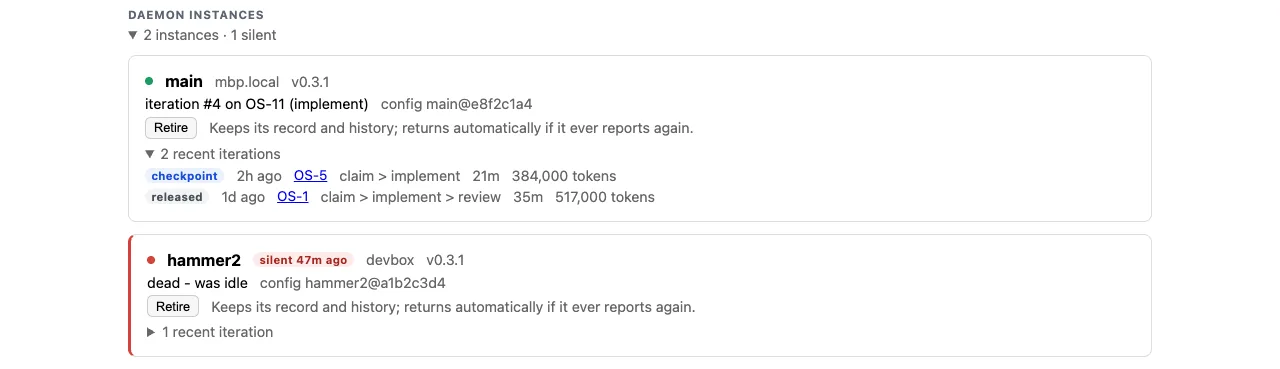
Every daemon reports what it is doing — the task it's on, the phase it's in, or that it's idle — and what it has done lately: recent iterations with duration and token spend. A daemon that stops reporting is marked, not dimmed, so the machine that went quiet overnight is the first thing you see.
Silence is loud
A daemon that stops reporting is marked, not hidden. Its row stays on the board with a red edge and the last thing it said it was doing — so a fleet that has gone silent shows up as silence, not as absence.
From loose ideas to claimable tasks
Store high-level thoughts and execution-ready specs in one backlog. Nothing reaches ready without a definition of done anyone could verify the same way — and claim isn't limited to fresh ready work: approved work awaiting its merge is served ahead of it, and abandoned in-progress work comes back as a takeover.
These are the readiness rungs, not the whole status set — in progress, in review, approved, blocked, parked, and done track work around the loop once it's claimable.
Connect an agent in one minute
Create a project, generate an API key, and add the server to your agent's MCP config.
{
  "mcpServers": {
    "clankerbar": {
      "type": "http",
      "url": "https://clankerbar.com/mcp",
      "headers": { "Authorization": "Bearer ${CLANKERBAR_API_KEY}" }
    }
  }
}
Want the backlog drained while you're away? The open-source clankerbar CLI is a supported command-line driver: it respawns agent sessions on your own machine, pauses through usage limits, takes its run configuration from ClankerBar with hot reload, and splits long tasks across fresh sessions at checkpoints. Its running instances appear on your Daemon instances panel.